Cluster-State Walkthrough
This page is a high-level how-to walkthrough for a more complete, multi-component QuantumSavory simulation.
The example distributes a four-qubit cluster state across four network nodes arranged in a square. Each node has a communication qubit, used to establish pairwise entanglement with neighbors, and a storage qubit, where that entanglement is moved and fused into the final multipartite resource state.
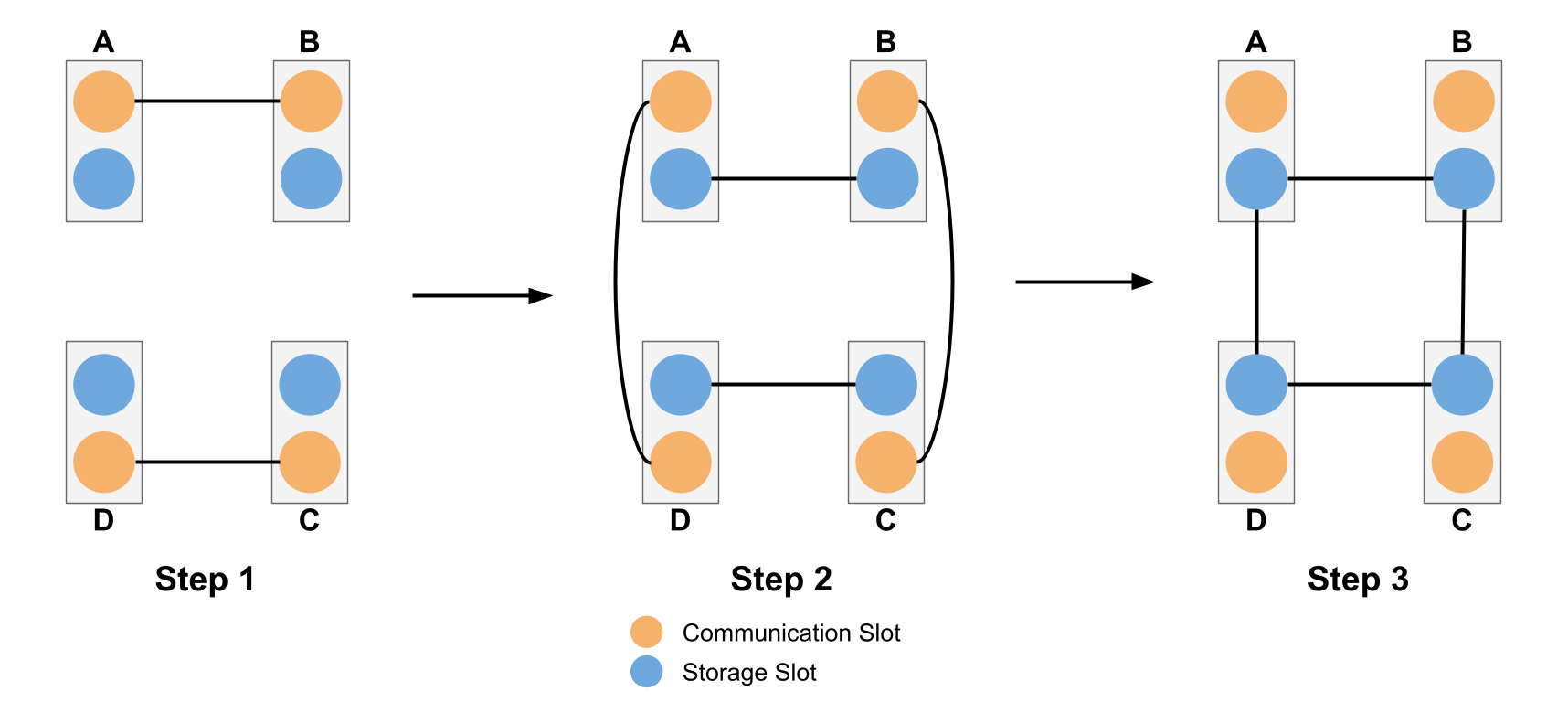
The diagram reads from left to right and shows one valid schedule for the four edges of the square:
- Step 1:
EntanglerProtworks on the A-B and C-D edges through the orange communication slots. These edges do not share a node, so the two entanglers can run in parallel. After both finish,Fusiontransfers these graph-state edges to the blue storage slots. - Step 2: The horizontal edges are now stored in the blue slots. The orange slots can be reused to entangle A-D and B-C in parallel.
- Step 3:
Fusionconsumes the second round of communication-slot Bell pairs and adds those edges to the stored state. The four blue storage slots now hold the square cluster state.
The two parallel rounds can occur in the opposite order. The important rule is that edges in one round do not share a node, so they do not compete for the same communication slot.
The point of this walkthrough is to show how a full-stack simulation is structured:
- independent link-level entanglers can run in parallel when they do not compete for the same communication qubits
- after all entanglers in a round finish, the
Fusioncircuit transfers those edges to the storage layer and frees the communication slots for the next round - protocol logic, waiting, and concurrency live in the discrete-event layer rather than being hand-managed in user code
- the state preparation and fusion steps can still be written symbolically, so the backend choice stays separate from the protocol logic
This is not a single-focus tutorial. It is closer to a how-to sketch of how one assembles registers, protocols, symbolic states, and concurrency into a larger simulation workflow.
Where To Go Next
- Read Architecture and Mental Model for the abstractions behind this workflow.
- Read Metadata and Protocol Composition for how protocols coordinate without tight coupling.
- Read How-To Guides for larger runnable end-to-end examples.