Architecture and Mental Model
QuantumSavory is built around a separation of concerns:
- symbolic descriptions express what state, operation, observable, or protocol logic you want,
- numerical backends decide how that quantum object is represented and evolved,
- registers and register networks provide the storage and interaction model, and
- a discrete-event simulator coordinates the classical control flow around the quantum dynamics.
This separation is what lets the same high-level model be reused across different simulation strategies.
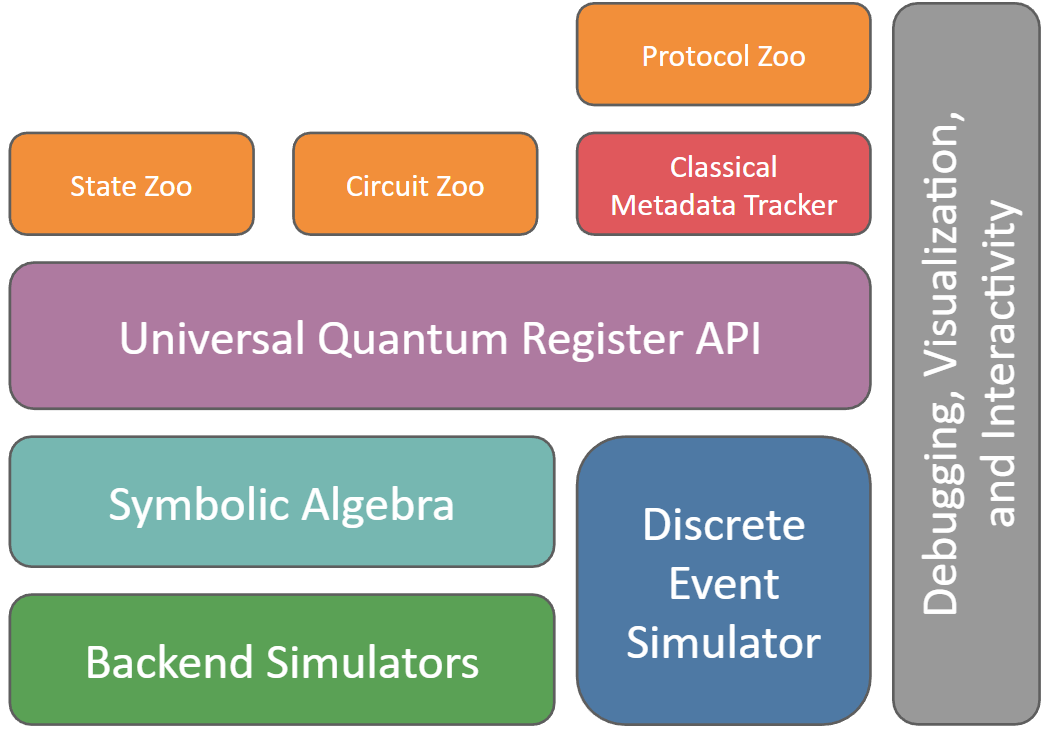
The diagram above summarizes the intended flow: the register interface sits at the center, symbolic descriptions and backend simulators stay decoupled, the StatesZoo, CircuitZoo, and ProtocolZoo provide reusable building blocks, and debugging or visualization can cut across the whole stack.
The Main Building Blocks
Registers and Register Networks
A Register stores local quantum subsystems such as qubits or modes. Each slot can carry its own physical properties and background processes. A RegisterNet groups registers into a networked simulation. Read Register Networks for its topology, indexing, metadata, naming, and delay interfaces.
Symbolic Frontend
States, operations, and observables can be written symbolically. This lets the user describe the intended physics first and defer the numerical representation decision to the backend. In practice, this means the user does not need to be an expert in the particular mathematics of each backend in order to build and compare models.
Numerical Backends
The symbolic frontend is not itself a simulator. QuantumSavory lowers symbolic objects to concrete representations such as stabilizer tableaux or wavefunctions when an operation, measurement, or time update needs them. This is valuable for two reasons: it allows the same model to run on fast specialized simulators when available, and it makes it possible to work with much more than ideal qubits, including bosonic modes and other heterogeneous subsystem types.
Discrete-Event Control
Many quantum-networking workflows are not just sequences of gates. They include waiting, message exchange, retries, and resource contention. QuantumSavory uses discrete-event simulation so protocols can model that control flow directly, while the bookkeeping of simulated time remains inside the framework rather than in ad hoc user code.
Metadata, Tags, and Protocol Composition
Protocols do not need to be tightly hard-wired to one another. Instead, they can coordinate through metadata attached to register slots or message buffers. This is one of the key ideas behind protocol composability in QuantumSavory: protocols publish and consume semantic facts about resources rather than being glued together with bespoke classical channels and explicit handles.
Declarative Noise and Time
Noise processes are configured as properties of the simulated hardware model, not manually rewritten for each backend. The symbolic layer and register interface are responsible for lowering those declarations into the chosen representation, while time evolution is tracked by the framework as operations and protocol events occur.
Log Domains
QuantumSavory uses Julia's standard log-record group field to classify records by subsystem. The stable groups are available as LOG_GROUPS, with backend, network, protocol, simulation, and visualization domains. A custom logger can filter on these symbols in Logging.shouldlog(logger, level, module, group, id) before the message and its metadata are constructed. Individual records can also carry an event metadata key for a more specific machine-readable event type.
The Zoos
QuantumSavory also ships reusable libraries of common states, circuits, and protocols through the StatesZoo, CircuitZoo, and ProtocolZoo submodules. These let users start from standard building blocks rather than reconstructing everything from scratch.
Structured Simulation Logging
QuantumSavory uses Julia's standard @debug, @warn, and @error macros for simulation, networking, protocol, and visualization records. Routine control flow is logged at Debug, recoverable anomalies at Warn, and invariant violations at Error. Messages are short, stable descriptions such as "Entangled a pair"; changing values belong in metadata instead of being interpolated into the message.
Library records follow this schema:
_groupis one ofLOG_GROUPS.backend,LOG_GROUPS.simulation,LOG_GROUPS.protocol,LOG_GROUPS.network, orLOG_GROUPS.visualization;eventis a stableSymbol;- simulation records include
sim_time::Float64andsim_process_id::Union{UInt,Nothing}; - protocol records additionally include
protocol::Symboland an immutable, orderednodes::Tuple{Vararg{Int}}; - event-specific fields use names such as
src_node,dst_node,remote_nodes,slot,slots,pair_id,round,attempts,message_type, andcorrection.
Use simulation_log_context for a free-function process:
@debug( "Swapped entanglement", _group=LOG_GROUPS.protocol, event=:entanglement_swapped, simulation_log_context(sim)..., protocol=:my_swapper, nodes=(node,), slots=(slot_a, slot_b), remote_nodes=(alice, charlie),)Use QuantumSavory.ProtocolZoo.protocol_log_context for an AbstractProtocol. It takes a node snapshot rather than retaining the protocol, simulation, network, register, message, or query object in the log record.
@debug( "Entangled a pair", _group=LOG_GROUPS.protocol, event=:pair_entangled, protocol_log_context(prot)..., round=round, slots=(a.idx, b.idx), pair_id=pair_id, attempts=attempts,)The _group keyword is special to Julia's logging macros. A logger can reject it through Logging.shouldlog before the message, context splat, and ordinary metadata are constructed. event and the other metadata are available only after the record has passed that early filter.
The library event vocabulary is organized by subsystem:
| Family | Events |
|---|---|
| Entangler | free_slots_unavailable, pair_entangled, attempts_exhausted |
| Tracker | message_received, slot_lock_requested, slot_lock_acquired, message_forwarded, deleted_qubit_update_applied, message_dropped, stale_message_dropped, message_wait_started, message_wait_finished |
| Consumer | entanglement_unavailable, query_invalidated, entanglement_consumed, stale_pair_dropped |
| Swapper and cutoff | swappable_pair_unavailable, counterpart_tag_conflict, swap_update_sent, deletion_message_sent |
| Switch | memory_assignment_unavailable, memory_slots_assigned, unused_entanglement_deleted, client_entanglement_failed, clients_entangled, swaps_scheduled |
| QTCP | flow_started, datagram_acknowledged, flow_completed, datagram_delivered |
| MBQC | graph_state_established, measurements_completed, remote_message_wait_started, remote_message_received, purification_succeeded, corrections_started, corrections_completed, purification_failed |
| Network | message_forwarded, message_received, message_arrived_without_waiter |
| Instructional protocols | Reuse the events above, plus entanglement_swapped, entanglement_failed, sensors_entangled, entanglement_target_reached, correction_received, fidelity_computed, round_started, client_fused, round_completed, and flow_window_increased |
| Visualization | initial_state_computed |
A Typical Simulation Flow
- Construct registers and, if needed, a register network.
- Choose subsystem properties and background processes.
- Initialize states and apply symbolic operations.
- Launch protocols as resumable processes in the discrete-event simulator.
- Query observables, inspect metadata, and visualize the resulting state.
Where To Go Next
- Read Register Interface for the main high-level operations.
- Read Choosing a Backend and Modeling Tradeoffs for the numerical side of the model.
- Read Discrete Event Simulator for the protocol execution model.
- Read Tagging and Querying for protocol coordination.